편집국 jyjang@sisabarotimes.com
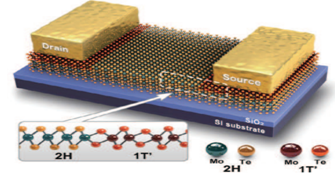
반도체 업계는 앞으로 50년 흑린,몰리브덴(Mo) 계열 등과 같은 2차원 물질이 실리콘을 대체할 것으로 보고있다. 2차원 물질을 반도체에 사용하면 휘어지는 전자기기에 활용가능하기 때문이다. 국내연구진이 세계 최초로 기존 공정을 이용해 2차원물질을 반도체로 만드는 데 성공했다.
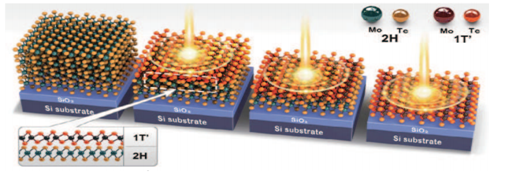 (Above: A simulation of the process of converting the 2H-MoTe2 into 1T'-MoTe2 with laser-irradiation)
이영희 기초과학연구원(IBS) 나노구조물리단장(성균관대 물리학과 교수)과 양희준 성균관대 에너지 과학부 교수 공동 연구진은 2차원물질인 '다이텔레륨 몰리브데늄(MoTe2)에 레이저를 쏴 전력손실이 적고 속도가 빠른 반도체 소자를 개발했다.
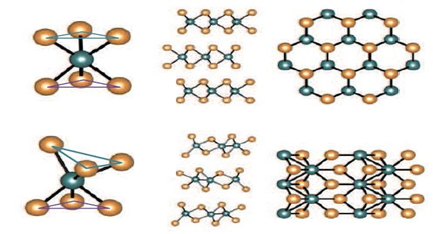 (Above: Top, 2H-MoTe2 Bottom, 1T’-MoTe2)
국내 연구진의 이번 성과는 세계적 과학 저널인 사이언스 6일자에 게재됐다. 2차원물질은 머리카락 굵기의 10만분의 1 정도로 얇은 물질로 그래핀(탄소원자가 6각형으로 배열된 물질)이후 많은 2차원물질이 발견됐으며 전기가 잘 통하고 휘어질 뿐만아니라 투명하기 때문에 차세대반도체로 평가받고 있다.
2004년 그래핀이 발견되었지만 점멸비가 나빠 전류의 흐름을 마음대로조절할 수 없는 한계가 있었다. 이러한 문제점을 해결하기위해 연구진들이 흑린,몰리브덴 계열,실리센 등과 같은 2차원 물질의 발견함에 따라 포스트 시리콘 경쟁이 치열해지고 있다.
이번 연구성과는 세계 최초로 기존 반도체 공정을 이용해 개발됐다는 점에서 집작도가 높아져 더 많은 데이터를 저장할 수 있고 빠른 속도로 처리할 수 있는 전자기기 개발이 가능하다는 점에서 차세대 반도체 출연을 앞당길 수 있는 획기적 기술로 평가받고 있다.
장 훈 녕 기자 hnjang@sisabarotimes.com
New 2D Transistor Material Made Using Precision Lasers
- A New Technique for Making 2D Transistor from dual-phase TMD Crystal -
August 7, 2015
Molybdenum ditelluride (MoTe2) is a crystalline compound that if pure enough can be used as a transistor. Its molecular structure is an atomic sandwich made up of one molybdenum atom for every two tellurium atoms. It was first made in the 1960’s via several different fabrication methods, but until last year it had never been made in a pure enough form to be suitable for electronics.
Last year a multi-discipline research team led by South Korea’s Institute for Basic Science (IBS) Center for Integrated Nanostructure Physics at Sungkyunkwan University (SKKU) director Young Hee Lee devised a fabrication method for the creation of pure MoTe2. Not only did they succeed in making MoTe2 in pure form, they were able to make two types of it — a semiconducting variety called 2H-MoTe2 (2H because of its hexagonal shape) and a metallic variety called 1T'-MoTe2 (1T’ because it has an octahedral shape) — which are both stable at room temperature.
Making MoTe2 in a pure form was very difficult and it was seen by some as a black sheep of the transition metal dichalcogenides (TMD) family and purposefully ignored. TMDs are molecules that can be made exceedingly thin, only several atomic layers, and have an electrical property called a band gap, which makes them ideal for making electrical components, especially transistors.
A TMD crystal follows an MX2 format: there is one transition metal, represented by M (M can be Tungsten, Molybdenum, etc.) and two chalcogenides, the X2 (Sulfur, Selenium, or Tellurium). These atoms form a thin, molecular sandwich with the one metal and two chalcogenides, and depending on their fabrication method can exist in several slightly different shaped atomic arrangements.
(출처 http://www.ibs.re.kr/eng.do)